
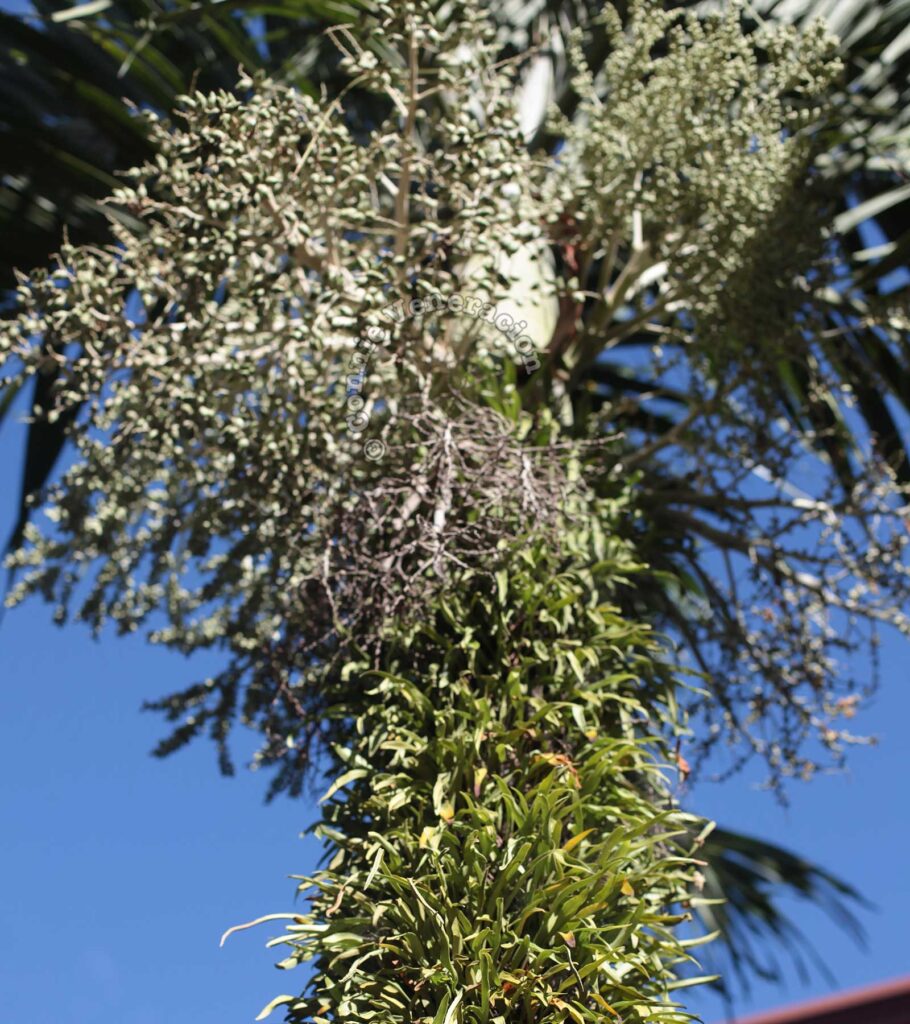
People who grow food in the garden are always on the lookout for parasitic and invasive weeds. If you have palm trees (especially coconuts) and you see fern growing on the trunk, should you get rid of the fern or not?
Opposite the mango tree, some twenty feet across the garden, grow two palm trees that are now as tall (or even taller) than our two-story house. For as long as I can remember, even when they were only half as high, fern has always grown on their trunks.
Alex and I were sitting in the garden after lunch and, with Speedy attending a college reunion, I was seated on the chair that he habitually occupies. In other words, from that angle, I had a different view of the garden. We were talking about the house behind ours, the one that was never occupied, and as I looked upward to stare at it, one of the palm trees partially covered my line of vision. The focus of my eyes shifted. If you do photography, it’s like twisting the lens of the camera so that the house was suddenly in the background, washed out, and the palm tree was in sharp focus.
For the first time, I entertained the thought of having the ferns pulled out in deference to the palm trees. The question, of course, was whether that was a wise— or even a necessary — move. Are they harmful to the palm trees? If they are, the palm tree should have died a long time ago. But they thrive as they always have. And the ferns make their trunks prettier and more interesting.
Ferns are not like mostplants that grow from seeds. Ferns reproduce asexually with unicellularspores. No pollination or germination of seeds required. The “primitive” reproduction may in part be explained by the fact that the earliest species of fern first appeared some 360 million years ago. But while the ferns we know today, including thevegetable fern that I so love to cook with coconut cream, are not the same as the ones that grew during the Devonian age, the species itself has been around for a long, long, long, long time. Ferns are so old that they figure in ancient Midsummer rituals in some Eastern European cultures.
But as interesting as the history of ferns may be, should we allow them in our garden? Some ferns are cultivated as ornamentals (my grandmother had pots and pots of them) while others are considered as invasive weeds. Some ferns are even parasitic — when they grow on live plants, they can sap the nutrients and the host plants can die.
But our palm trees where the ferns grow have shown no signs of dying. So, the fern that grows on their trunks can’t be parasitic. And the ferns don’t grow beyond the confines of the palm tree trunks so they’re not invasive. So, I think we’ll just let them be. Live and let live.
Discover more from Connie Veneracion
Subscribe to get the latest posts sent to your email.
